

Comparing Pavement Management Software Features for Multi-Project Operations
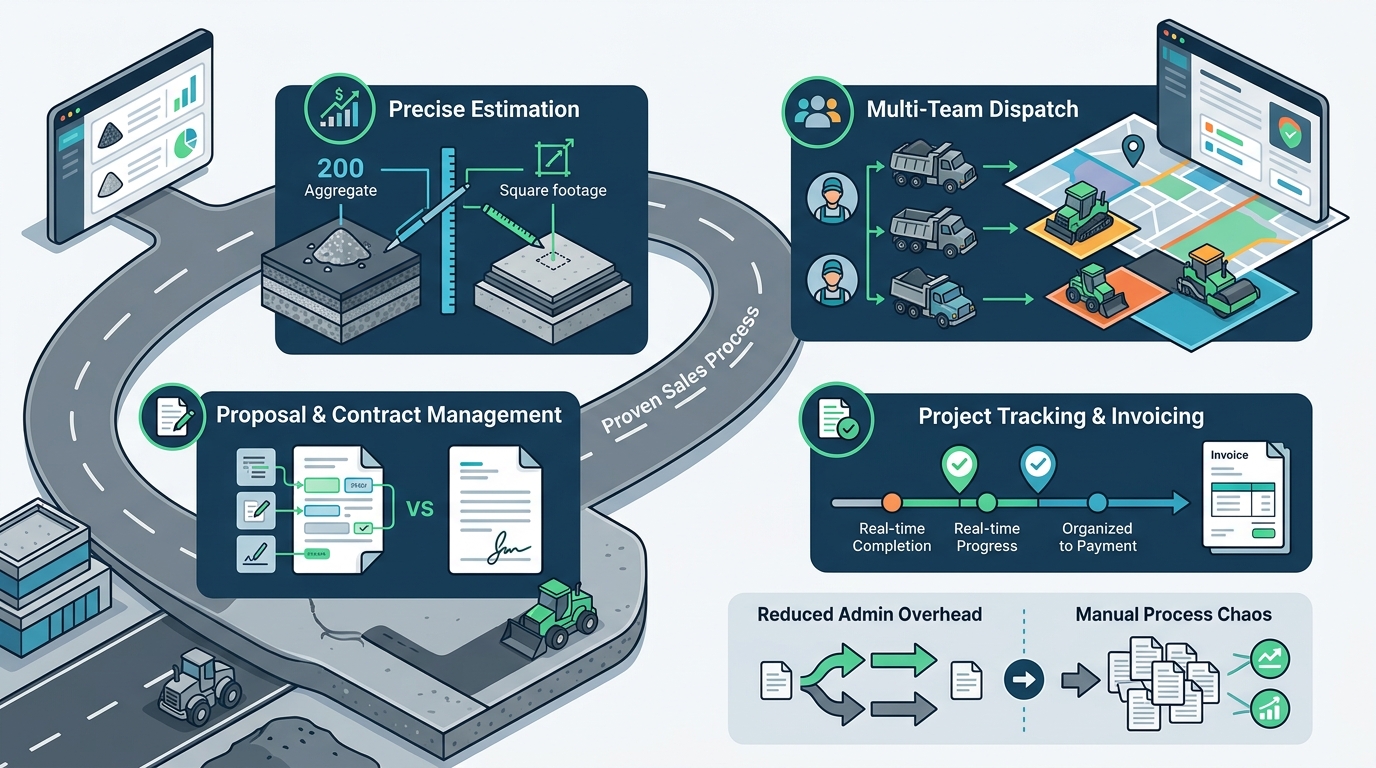
Managing a growing pavement contracting business requires more than just heavy machinery and skilled crews. It demands a centralized digital infrastructure that can handle complex workflows across multiple job sites simultaneously. According to industry data, firms that implement specialized process software see a significant reduction in administrative overhead, allowing them to scale operations without proportional increases in office staff. This article compares the critical features required for multi-project pavement management, focusing on how modern cloud-based solutions streamline the journey from prospect to invoice.
Why Standard Tools Fail Multi-Project Operations
As a pavement company expands from a single truck to a fleet of twenty or more, the complexity of operations does not grow linearly; it grows exponentially. Many contractors attempt to manage this growth using generic project management tools or disjointed spreadsheets. This approach often leads to data silos where estimating, field operations, and accounting cannot communicate effectively.
Pavement Layers is a proven sales process supported with simple-to-use software designed specifically to bridge this gap. Unlike generic tools, specialized pavement management software understands the unique lifecycle of a paving job. It moves beyond simple task lists to manage the entire business process, from the initial prospect to the final work order. When you are managing multiple projects, the ability to see the real-time status of every lead and job is not a luxury; it is a necessity for maintaining cash flow and operational efficiency.
For firms that have been in business for years, the transition to a unified system can feel daunting. However, the cost of inaction is often higher. Without a centralized system, office staff spend hours reconciling data, and field crews lack the immediate access to accurate scopes of work. This disconnect creates friction that slows down project delivery and frustrates both employees and clients.
Core Feature Comparison for Scaling Firms
When evaluating software for multi-project operations, you must look beyond basic contact management. The following table compares the essential features required for scaling pavement businesses, highlighting how specialized platforms like Pavement Layers address these needs.
| Feature Category | Generic CRM/Project Tools | Specialized Pavement Software (e.g., Pavement Layers) |
|---|---|---|
| Proposal Generation | Manual document creation, static templates, no site-specific imagery integration. | Customized proposals created in minutes with maps, site photos, and preloaded specs. |
| Estimating Accuracy | Disconnected from field data, reliant on manual input and historical guesswork. | Integrated estimating tools that link directly to work orders and job costs. |
| Field-to-Office Sync | Limited mobile access, delayed data entry, poor real-time visibility. | Real-time tracking of won, lost, closed, open, and canceled projects for each user. |
| Accounting Integration | Requires complex middleware or manual data export/import processes. | One-click integration with QuickBooks Desktop and Online. |
| Scalability | Often requires expensive enterprise licenses or custom development for growth. | Tiered pricing models supporting 1-5 users up to 21+ users with consistent features. |
The distinction lies in the depth of industry-specific functionality. Generic tools force you to adapt your business to their workflow. Specialized pavement software adapts to your proven process, ensuring that every feature supports the core activities of paving, sealcoating, and concrete work.
Proposal and Estimating Precision
In the pavement industry, speed and accuracy in proposal generation are directly correlated to win rates. When managing multiple projects, the ability to produce high-quality proposals rapidly is a competitive advantage. Creating, organizing, sending, editing, and customizing proposals that customers love in less than 5 minutes is a standard capability of modern pavement management platforms.
These systems allow you to include critical details such as driving directions, site images, and specific scope of work definitions directly within the proposal. This level of detail reduces ambiguity and sets clear expectations for the client before the contract is even signed. Furthermore, the integration of preloaded specifications for services like milling, base repair, infrared repairs, and line striping ensures that your estimates are consistent and comprehensive.
For multi-project operations, this feature also supports a collaborative workflow. Sales team members who are not yet ready to price projects can produce parts of the proposal for approval. This approval process ensures quality control while maintaining the speed of the sales cycle. The ability to upload images with measurements and repair zones from field apps like WheelitOff further enhances the accuracy of these proposals.
Sales Pipeline and Real-Time Tracking
One of the most significant challenges in multi-project operations is visibility. Owners and managers need to know exactly where every lead stands in the pipeline without having to chase down individual team members. Sales team real-time tracking of won, lost, closed, open, and canceled projects for each user eliminates the guesswork that often plagues growing businesses.
Real-time tracking allows you to identify bottlenecks in your sales process. If you notice that leads are stalling at the proposal stage, you can intervene with additional training or support. If certain users are consistently closing more deals, you can analyze their workflow to replicate their success across the team. This data-driven approach to sales management is essential for scaling a pavement company effectively.
Additionally, the system provides notifications via email for new leads, opened proposals, forwarded proposals, and detailed work orders. This automated communication ensures that no opportunity falls through the cracks, which is critical when managing a high volume of concurrent projects. The ability to track these metrics in real-time transforms your sales team from a group of individuals into a cohesive, high-performing unit.
Integration and API Connectivity
No software exists in a vacuum. For a pavement company to operate efficiently, its management tools must communicate seamlessly with other critical systems, particularly accounting software. One-click integration with QuickBooks Desktop and Online is a standard feature in top-tier pavement management platforms, ensuring that financial data flows accurately between estimating and invoicing.
Beyond accounting, the ability to integrate with other tools via an API is crucial for customizing your tech stack. For example, you might use WheelitOff for iPad measuring, marking, and presentation. A robust pavement management system will offer one-click integration with such specialized tools, creating a unified ecosystem that reduces data entry errors and saves time.
This connectivity extends to other aspects of the business as well. Whether you are using specific hardware for site inspections or specialized software for fleet management, the right pavement management platform will provide the flexibility to connect these tools. This interoperability ensures that your business processes remain streamlined as you adopt new technologies to improve efficiency.
Key Takeaways
- Specialized Process: Pavement Layers is a proven sales process supported with simple-to-use software, not just a generic CRM.
- Rapid Proposal Creation: Users can create, organize, send, edit, and customize proposals that customers love in less than 5 minutes.
- Real-Time Visibility: The platform offers real-time tracking of won, lost, closed, open, and canceled projects for each user.
- Accounting Integration: One-click integration with QuickBooks Desktop and Online ensures accurate financial data flow.
- Scalable Pricing: Pricing tiers support businesses from 1-5 users ($2,500/person/year) to large enterprises with 21+ users ($1,900/person/year).
- Quick Onboarding: Complete setup can be achieved in less than 2 hours with included support and training.
- Device Agnostic: The cloud-based solution works from any device connected to the internet, including laptops, PCs, Macs, iPads, and smartphones.
Frequently Asked Questions
What is Pavement Layers?
Pavement Layers is a cloud-based software that enables users to create, organize, estimate, edit, and send customized pavement proposals with images. It supports the entire process from prospect to lead to estimate to proposal to work order to job cost, integrating with most invoicing systems via API.
How long does it take to produce a proposal?
The first proposal may take approximately 15 minutes using a simple one-finger process. After reviewing the quick start videos, users can produce amazing proposals in less than 5 minutes. These proposals can include links to reference sheets, insurance, workers' compensation, and images with repair locations.
Do you provide specifications or can we use our own?
Both. Pavement Layers provides an excellent set of specifications for paving, repairs, milling, base repair, infrared repairs, sealcoating, crack sealing, line striping, concrete, drainage, curbing, sweeping, and more. You can also modify the provided specifications or completely customize them to fit your specific needs.
Is there a free trial available?
Yes. A free 14-day trial is offered. When you sign up, you receive detailed instructions and help from the team to be up and running in under an hour. This allows you to evaluate the software's impact on your multi-project operations before committing.
How does the pricing structure work for growing teams?
Pricing is based on the number of users. Small businesses (1-5 users) pay $2,500 per person per year. Medium businesses (6-20 users) pay $2,200 per person per year. Large businesses (21+ users) pay $1,900 per person per year. Office staff, secretaries, or controllers cost an additional $500 per year.
Can the software integrate with other tools?
Yes. The platform offers one-click integration with QuickBooks Desktop and Online. It also integrates with WheelitOff for measuring and marking, as well as ProSiteAudit Inspection. An API is available for integration with other market-leading systems.
What devices are supported?
The software is cloud-based and works from any web-enabled device connected to the internet. This includes laptops, PCs, Macs, iPads, Android tablets, and iPhones. This flexibility allows your sales team and office staff to access critical data from anywhere.
Next Steps for Your Business
Scaling your pavement company requires more than just adding more trucks; it requires adding more efficiency. By choosing a software solution that understands the nuances of pavement management, you can streamline your operations, improve your win rates, and reduce administrative burden. Start your 14-day free trial today to see how Pavement Layers can transform your multi-project operations. For more information on our features and pricing, visit our FAQ page or review our value proposition. If you have specific questions about integrating with your current tech stack, contact our team directly. To learn more about our history and client success stories, check out our testimonials and case studies.