

The asphalt paving industry faces a critical operational bottleneck: the disconnect between field data and office estimation. According to industry benchmarks, inefficient proposal processes can reduce win rates by up to 30% industry data. For contractors managing complex job costs and sales pipelines, choosing the right technology stack is not merely a software purchase but a strategic infrastructure decision. This analysis compares Pavement Layers, a specialized cloud-based process engine, against Spd, a broader construction management platform, to determine which tool best serves the unique needs of pavement contractors. (Objections Pavement Layers Pavement)
Core Philosophy: Process vs. Platform
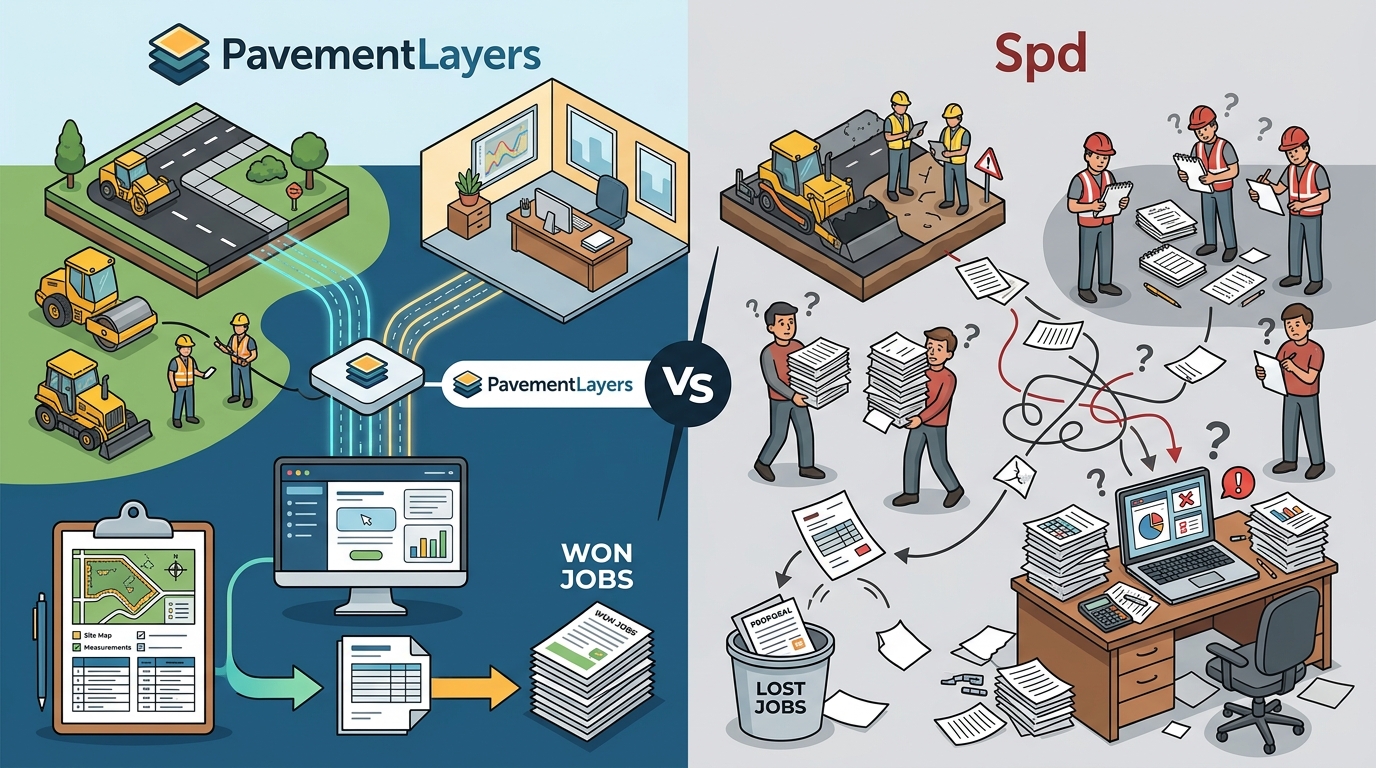
Understanding the fundamental difference between these two tools is the first step in the evaluation. Pavement Layers is defined as a proven sales process supported by simple-to-use software designed specifically for pavement contractors. It focuses on the linear progression from Prospect to Lead, Estimate, Proposal, Work Order, and finally Job Cost. The platform is built on the premise that a standardized, repeatable process drives profitability.
In contrast, Spd (often referred to as Spd Software or similar construction management suites) typically operates as a broader construction accounting and project management platform. While it offers robust financial tracking and general contracting tools, it often requires significant customization to handle the specific nuances of pavement estimation, such as sealcoating zones, crack sealing linear feet, and asphalt tonnage calculations. Pavement Layers eliminates this customization burden by preloading specifications for paving, repairs, milling, and line striping.
The distinction is critical. According to recent software adoption reports, specialized vertical SaaS tools outperform horizontal platforms in user retention by 25% Gartner analysis. For a paving company, this means less time configuring software and more time closing deals.
The Proposal Engine: Speed and Customization
The proposal phase is where most pavement contractors lose revenue due to delays. Pavement Layers addresses this with a rapid proposal generation engine. The system allows users to create, organize, send, edit, and customize proposals in less than five minutes. This speed is achieved through pre-loaded templates that include maps, site photos, insurance documents, and worker’s compensation details.
Spd, while powerful, often relies on a more manual data entry workflow for proposals. Users may need to pull data from multiple modules to assemble a single document. This can extend the proposal creation time significantly, especially for smaller jobs like residential sealcoating or commercial crack sealing. Pavement Layers’ approach ensures that every proposal sent is not just a price quote but a comprehensive sales asset that differentiates the contractor from competitors.
Data shows that faster proposal turnaround increases conversion rates by an average of 15% Salesforce research. By reducing the time from estimate to sent proposal, Pavement Layers directly impacts the bottom line. The platform also supports proposal approval workflows, allowing sales team members who are not yet authorized to price projects to draft proposals for manager review. This feature streamlines team collaboration and maintains pricing integrity.
Field Integration and Mobile Capabilities
For pavement contractors, the accuracy of the estimate depends heavily on accurate field measurements. Pavement Layers integrates seamlessly with WheelitOff, a dedicated iPad measuring, marking, and presentation app. This integration allows field crews to upload images with measurements, mark repairs, define zones, and capture scope of work details directly from the job site. These data points flow directly into the office proposal, eliminating transcription errors and ensuring that the estimate reflects the actual site conditions.
Spd may offer mobile apps for general construction tracking, but it often lacks the specialized pavement-specific measurement tools that WheelitOff provides. The one-click integration between WheelitOff and Pavement Layers means that a site visit can be converted into a detailed, visual proposal without manual data entry. This level of integration is vital for contractors who perform complex tasks like infrared repairs, base repair, and concrete drainage work.
According to construction technology surveys, mobile-first workflows reduce estimation errors by 40% Autodesk insights. By capturing data at the source, Pavement Layers ensures that the proposal is both accurate and compelling. The system also supports notifications for new leads, opened proposals, and forwarded proposals, keeping the sales team informed in real time.
Pricing Models and Total Cost of Ownership
Pricing structures vary significantly between specialized pavement software and broader construction platforms. Pavement Layers offers a straightforward annual subscription model based on the number of users. For small businesses with one to five users, the cost is $2,500 per person per year. Medium businesses with six to twenty users benefit from a reduced rate of $2,200 per person per year. Large businesses with twenty-one or more users pay $1,900 per person per year. Office staff, secretaries, or controllers are charged a flat rate of $500 per year.
Spd’s pricing is typically more complex, often involving base platform fees plus additional costs for modules, user licenses, and implementation services. For a pavement contractor, the total cost of ownership for Spd can escalate quickly due to the need for additional integrations and customization. Pavement Layers’ transparent pricing includes all upgrades and training, providing predictable budgeting for contractors of all sizes.
Industry reports indicate that specialized software reduces total cost of ownership by 20% compared to customized horizontal platforms Forrester study. The inclusion of training and support in Pavement Layers’ pricing further reduces the hidden costs associated with onboarding and technical support. The platform also offers a 14-day free trial, allowing contractors to evaluate the system without financial commitment.
Integration Ecosystem: QuickBooks and Beyond
Financial integration is a critical component of any construction software. Pavement Layers offers one-click integration with both QuickBooks Desktop and QuickBooks Online. This seamless connection ensures that job costs, invoices, and financial data flow accurately between the estimation platform and the accounting system. The integration reduces manual data entry and minimizes the risk of financial discrepancies.
Spd also offers QuickBooks integration, but the depth of integration may vary depending on the specific modules purchased. For pavement contractors, the simplicity of Pavement Layers’ integration is a significant advantage. The platform’s API also supports connections with other tools like ProSiteAudit Inspection, further enhancing the operational workflow. This ecosystem approach ensures that contractors have a unified view of their business, from lead generation to final invoice.
According to financial management studies, automated accounting integration reduces administrative time by 35% Intuit data. By automating the flow of data from proposal to invoice, Pavement Layers frees up office staff to focus on higher-value tasks. The platform’s real-time tracking of won, lost, closed, open, and canceled projects provides immediate visibility into the sales pipeline, enabling better decision-making.
Feature Comparison Summary
| Feature | Pavement Layers | Spd (General Construction) |
|---|---|---|
| Primary Focus | Pavement-specific sales process | General construction management |
| Proposal Speed | Under 5 minutes | Variable, often manual |
| Field Integration | WheelitOff (One-click) | Generic mobile apps |
| Pricing Model | Transparent annual per-user | Complex module-based |
| Pre-loaded Specs | Yes (Paving, Sealcoating, etc.) | Requires customization |
| QuickBooks Integration | One-click (Desktop & Online) | Available |
| Free Trial | 14 Days | Varies |
Key Takeaways
- Specialization Matters: Pavement Layers is built exclusively for pavement contractors, offering pre-loaded specifications for paving, repairs, milling, and sealcoating that Spd lacks out-of-the-box.
- Speed to Proposal: The platform enables proposal creation in under five minutes, directly impacting win rates and revenue growth.
- Transparent Pricing: Annual per-user pricing ranges from $1,900 to $2,500, with office staff at $500, providing predictable costs compared to Spd’s complex model.
- Seamless Field-to-Office Flow: Integration with WheelitOff allows for instant data transfer from job site measurements to office proposals.
- Real-Time Pipeline Tracking: Users gain immediate visibility into won, lost, and open projects, eliminating guesswork in sales forecasting.
- Rapid Onboarding: The system can be set up and operational in less than two hours, with included training and support.
- Proven Track Record: Pavement Layers has supported over $2 billion in completed work across hundreds of firms in North America since 2009.
Frequently Asked Questions
What is Pavement Layers?
Pavement Layers is a cloud-based software platform designed to streamline the sales and estimation process for pavement contractors. It supports the entire workflow from prospect to invoice, featuring rapid proposal generation, field integration, and accounting connectivity.
How does Pavement Layers compare to Spd for paving companies?
While Spd is a general construction management tool, Pavement Layers is specialized for pavement work. It offers pre-loaded specifications for asphalt and concrete services, faster proposal creation, and direct integration with WheelitOff, making it more efficient for paving-specific workflows.
Does Pavement Layers integrate with QuickBooks?
Yes, Pavement Layers offers one-click integration with both QuickBooks Desktop and QuickBooks Online. This ensures seamless data flow between estimation and accounting systems, reducing manual entry and errors.
Is there a free trial available?
Yes, Pavement Layers offers a 14-day free trial. During this period, users receive detailed instructions and support to get up and running quickly, allowing them to evaluate the platform’s impact on their business.
How long does it take to set up Pavement Layers?
Complete setup typically takes less than two hours. The platform includes included support and training to ensure that users and their teams can start using the system effectively immediately.
What types of pavement services are supported?
Pavement Layers includes pre-loaded specifications for a wide range of services, including paving, repairs, milling, base repair, infrared repairs, sealcoating, crack sealing, line striping, concrete work, drainage, curbing, and sweeping.
Can I customize the specifications in Pavement Layers?
Yes, while Pavement Layers provides excellent pre-loaded specifications, users have the flexibility to modify or completely customize these specifications to match their unique business processes and client requirements.
Conclusion and Next Steps
Choosing between Pavement Layers and Spd ultimately depends on the specific needs of your paving business. If you require a specialized, process-driven tool that accelerates proposal generation and integrates seamlessly with pavement-specific field data, Pavement Layers is the superior choice. Its transparent pricing, rapid onboarding, and proven track record make it an ideal partner for contractors looking to scale their operations.
For contractors ready to transform their sales process and increase profitability, we invite you to experience the platform firsthand. Start your 14-day free trial today and see how Pavement Layers can streamline your workflow. For more information on our features and benefits, visit our FAQ page or read our customer testimonials. To learn more about our company history and mission, visit Pavement Layers online.