

Common Mistakes in Organizing Pavement Estimates and How to Fix Them
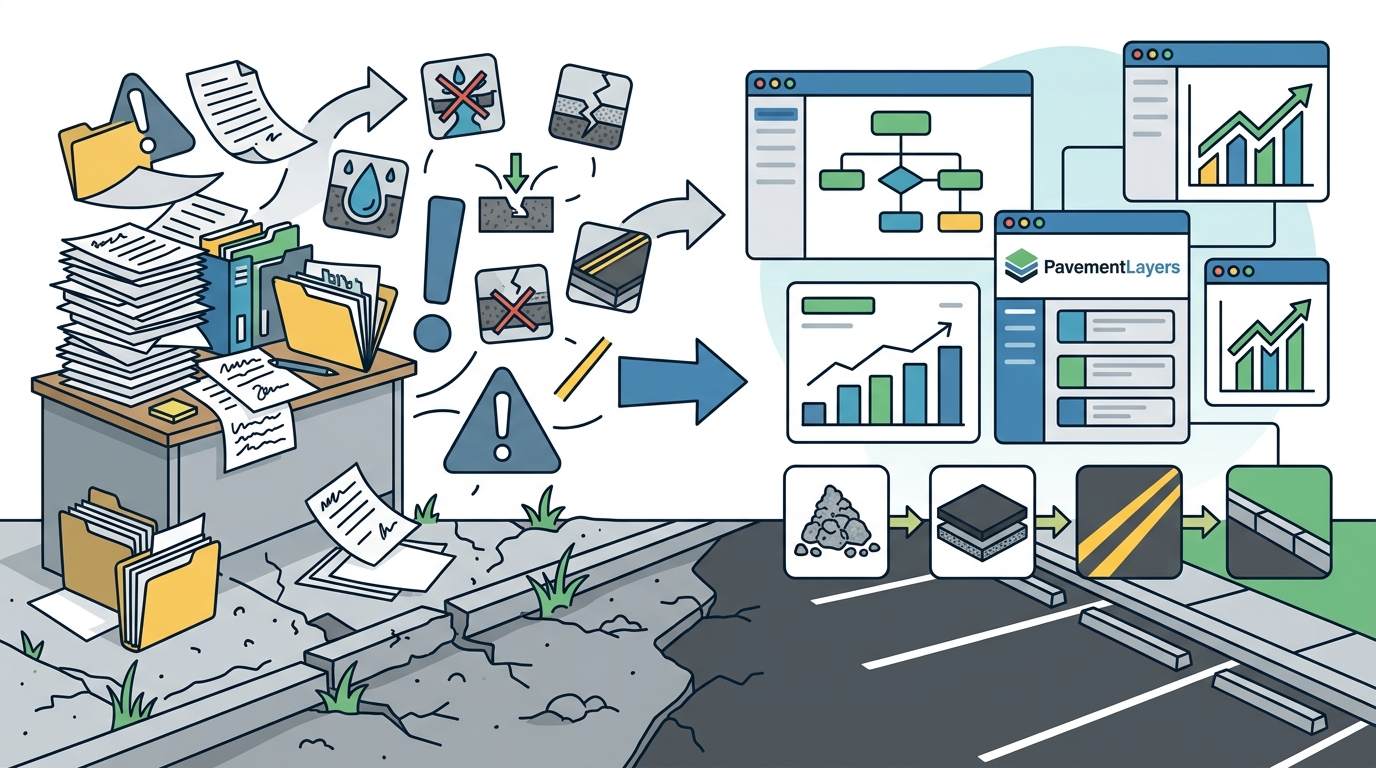
Organizing pavement estimates is not just about calculating material costs. It is about capturing the entire scope of work, from site preparation to final striping, without missing hidden variables. According to industry data, inaccurate estimates are the primary cause of lost bids and reduced profit margins in the paving sector. When estimates are disorganized, sales teams lose track of critical details, leading to proposals that either price too high to win or too low to profit. This guide details the most frequent organizational failures in pavement estimating and provides the structural solutions needed to correct them. (Paving Sealcoating Concrete Pavement)
Mistake 1: Incomplete Scope of Work Documentation
One of the most critical errors in pavement estimating is failing to document every component of the scope of work. Estimators often focus heavily on the primary material, such as asphalt or concrete, while neglecting ancillary costs. These ancillary costs include site preparation, milling, base repair, drainage adjustments, and final striping. When these elements are omitted or estimated vaguely, the final job cost exceeds the proposal price, eroding profit margins.
To avoid this, you must adopt a comprehensive checklist approach. Every estimate should include preloaded specifications for all services you perform. This includes paving, repairs, milling, base repair, infrared repairs, sealcoating, crack sealing, line striping, concrete work, drainage, curbing, and sweeping. By standardizing these specifications, you ensure that no line item is overlooked. This method transforms the estimating process from a guesswork exercise into a precise calculation of actual costs.
For more insights on building a robust estimating framework, review our feature overview which details how to manage these complexities.
Mistake 2: Ignoring Real-Time Sales Pipeline Tracking
Another common failure is the lack of real-time tracking for the sales pipeline. Many pavement companies rely on static spreadsheets or memory to track the status of leads and proposals. This leads to a state of uncertainty where office staff and sales teams do not know the exact status of open, closed, won, lost, or cancelled projects. This ambiguity causes delays in follow-up and results in missed opportunities.
The solution is to implement a system that provides real-time visibility into the sales pipeline. This allows you to see exactly where each prospect stands in the journey from lead to work order. Real-time tracking eliminates the guesswork and ensures that no lead falls through the cracks. It also enables management to forecast revenue more accurately by providing a clear view of the projected workload.
Learn more about how our FAQ addresses pipeline management and lead tracking.
Mistake 3: Manual Data Entry and Disconnected Systems
Manual data entry is a significant source of error and inefficiency in pavement estimating. When estimators manually input data into multiple systems, such as separate tools for CRM, estimating, and accounting, the risk of human error increases dramatically. This fragmentation also creates data silos, where information is not easily accessible across the organization.
To correct this, you need an all-in-one, cloud-based solution that integrates seamlessly with your existing tools. Integration with accounting software like QuickBooks Desktop and Online is essential for smooth financial operations. Additionally, integrating with field measurement tools like WheelitOff allows for direct upload of images and measurements from the site. This one-click integration ensures that the data entered in the estimate is accurate and directly linked to the field conditions.
Discover how our integration capabilities solve these connectivity issues.
Failure to Standardize Proposal Customization
Proposals are the final touchpoint with the client before a contract is signed. If proposals are not customized and professional, they can fail to differentiate your company from competitors. Many estimators spend hours creating proposals from scratch, leading to inconsistency in branding and content. This inefficiency also delays the submission of bids, which can result in losing the job to a faster competitor.
The fix is to use a proposal management system that allows for rapid customization. You should be able to create, edit, and send customized proposals in less than five minutes. These proposals should include maps, site photos, references, insurance certificates, and preloaded specifications. By standardizing the template and content, you ensure that every proposal is professional, accurate, and tailored to the specific project needs. This speed and quality help win better work faster.
See our testimonials to see how other firms have improved their proposal process.
Lack of Integration with Field Operations
Estimates are often created in isolation from the field operations team. This disconnect can lead to proposals that are technically unfeasible or overly optimistic about execution time. When estimators do not have access to real-time field data, such as site conditions or crew availability, their estimates may not reflect the true cost of labor and equipment.
To bridge this gap, your estimating software should integrate with field tools. For example, using an iPad app like WheelitOff allows you to measure and mark repair zones directly on site. These measurements and images can then be uploaded directly into the estimate. This ensures that the proposal is based on accurate, on-the-ground data. It also facilitates better communication between the office and the field, ensuring that everyone is aligned on the scope of work.
Neglecting Post-Proposal Follow-Up Protocols
Even the best estimates can fail if the follow-up process is neglected. Many pavement companies struggle with tracking whether a proposal has been opened, forwarded, or reviewed by the client. Without this visibility, sales teams cannot prioritize their efforts or intervene when necessary. This lack of follow-up often results in lost deals that could have been won with timely communication.
Implement a system that sends notifications for new leads, opened proposals, forwarded proposals, and detailed work orders. This automated tracking ensures that no opportunity is missed. It also provides valuable data on which proposals are gaining traction and which need additional attention. By monitoring these metrics, you can refine your sales strategy and improve your win rate.
Comparison of Estimating Approaches
Understanding the difference between traditional and modern estimating methods is crucial for improvement. The table below summarizes the key differences.
| Feature | Traditional Method | Modern Cloud-Based Method |
|---|---|---|
| Data Entry | Manual, prone to errors | Automated, one-click integration |
| Proposal Speed | Hours to days | Less than 5 minutes |
| Pipeline Visibility | Static, limited | Real-time, comprehensive |
| Field Integration | Disconnected | Seamless (e.g., WheelitOff) |
| Accounting Sync | Manual export/import | Direct QuickBooks integration |
Key Takeaways
- Incomplete scope documentation leads to profit erosion and inaccurate job costing.
- Real-time sales pipeline tracking eliminates guesswork and improves forecasting.
- Manual data entry creates errors; cloud-based integration ensures accuracy.
- Standardized proposals can be created in under five minutes, increasing win rates.
- Integration with field tools like WheelitOff provides accurate site data.
- Automated follow-up notifications prevent lost opportunities.
- PavementLayers has been serving the industry since 2009, providing proven process support.
Frequently Asked Questions
What is the primary benefit of using cloud-based pavement estimating software?
The primary benefit is the ability to access real-time data from any device, ensuring that estimates are accurate, up-to-date, and easily shareable with clients and field teams.
How long does it take to produce a professional proposal?
With the right tools, you can produce a customized, professional proposal in less than five minutes after the initial setup. The first proposal may take up to 15 minutes as you learn the system.
Does the software integrate with accounting systems?
Yes, the software offers one-click integration with both QuickBooks Desktop and QuickBooks Online, streamlining the transition from estimate to invoice.
Can I customize the specifications in the software?
Absolutely. While preloaded specifications are provided for common services, you can fully customize or modify them to match your company’s specific standards and pricing models.
Is there a free trial available?
Yes, a free 14-day trial is available. This allows you to test the features, including proposal creation and pipeline tracking, before committing to a subscription.
How does the software help with sales pipeline management?
It provides real-time tracking of all projects, categorizing them as Won, Lost, Closed, Open, or Cancelled. This visibility helps management understand the health of the sales funnel.
What is WheelitOff?
WheelitOff is an iPad measuring, marking, and presentation app that integrates with the estimating software. It allows for direct upload of site images and measurements to proposals.
Take Control of Your Estimating Process Today
Stop letting disorganized estimates cost you profitable jobs. By addressing these common mistakes and implementing a structured, cloud-based solution, you can streamline your workflow, improve accuracy, and increase your win rate. Join the hundreds of firms across North America that have transformed their operations with PavementLayers. Start your free 14-day trial today and see the difference a proven process can make for your business.