

Cloud-based software for pavement companies is a web-hosted platform that centralizes sales, estimation, and project data to eliminate local hardware dependencies. It allows teams to access real-time project status, financials, and client communications from any internet-connected device. This guide covers the operational benefits of cloud adoption, focusing on scheduling, data accessibility, cost tracking, and centralized management for pavement professionals.
Scheduling and Dispatching
Efficient dispatching is the backbone of a profitable pavement operation. Traditional paper-based or local software systems often create information silos where the office does not know the real-time status of field crews. Cloud-based pavement software solves this by providing a single source of truth for job assignments and crew locations. This reduces the time spent on phone tag and ensures that resources are allocated based on current availability rather than outdated spreadsheets.
Real-Time Work Order Distribution
Modern cloud platforms allow office staff to send detailed work orders directly to field devices. These orders include driving directions, scope of work, and site images. When a crew leader receives a notification, the job is immediately marked as active in the system. This transparency allows the office to track progress without constant manual check-ins, freeing up administrative staff to focus on higher-value tasks like proposal generation.
Reducing Idle Time and Fuel Costs
Idle time is a significant hidden cost in the paving industry. When dispatchers have live visibility into crew status, they can optimize routes and reduce unnecessary travel between sites. This efficiency directly impacts fuel consumption and equipment wear. By streamlining the dispatch process, pavement companies can increase the number of billable hours per crew without adding headcount.
Centralized Data Accessibility
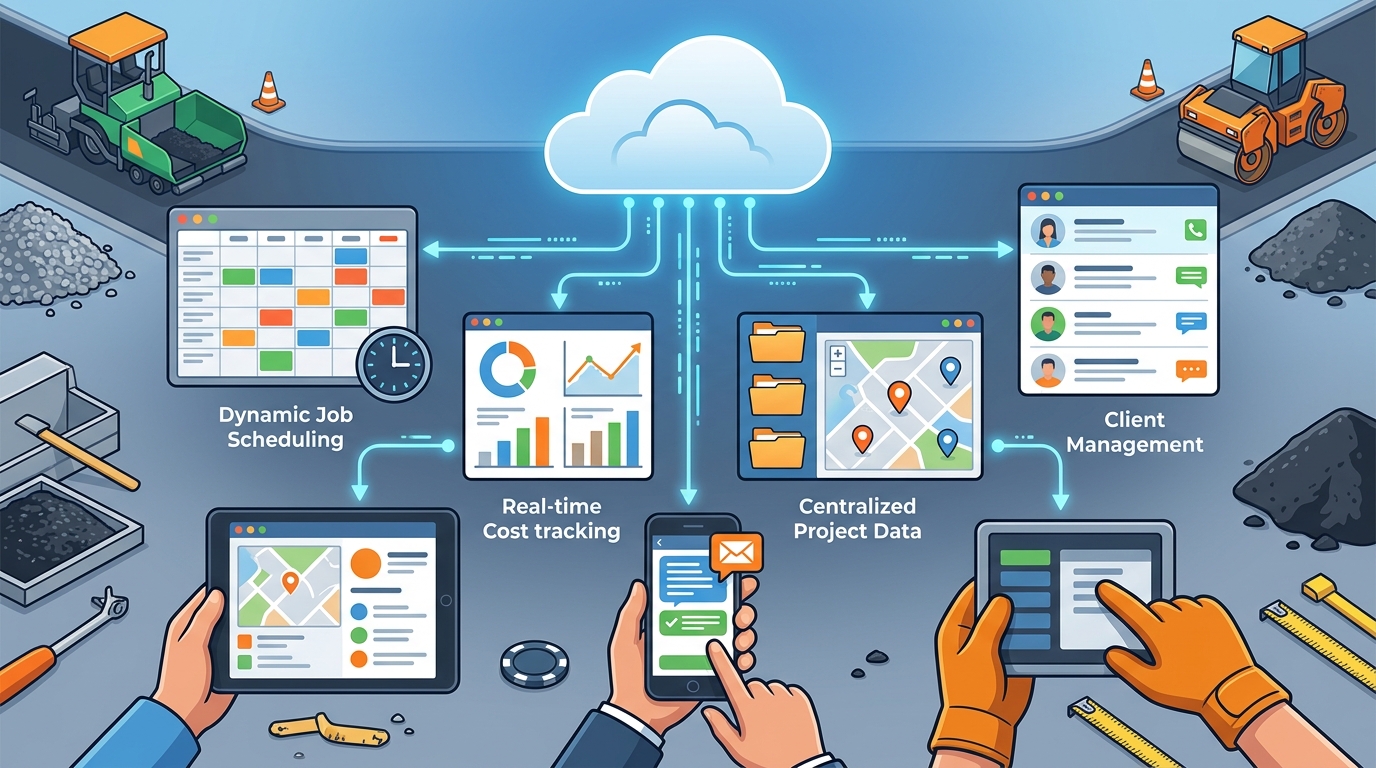
Centralized data accessibility is the ability for all authorized users to view and interact with the same business information from any location. In a cloud environment, data is stored on secure remote servers rather than local hard drives. This means that a CEO in the office, a sales rep in the field, and a project manager on a job site are all looking at the same live data. This eliminates version control issues and ensures that every decision is made with the most current information available.
Device Agnostic Access
Cloud-based solutions are designed to work on any web-enabled device, including laptops, tablets, and smartphones. This flexibility is crucial for pavement companies where field personnel rarely sit at a desktop computer. Whether using an iPad in a truck or a smartphone on a job site, users can access client records, proposal history, and project details instantly. This mobility ensures that business operations continue seamlessly even when staff are away from the office.
Collaborative Decision Making
When data is centralized, collaboration becomes significantly faster. Sales teams can share client insights with project managers in real time. If a client requests a change to a proposal, the update is visible to the entire team immediately. This reduces the risk of miscommunication and ensures that all stakeholders are aligned on project scope and expectations. The result is a more cohesive team that can respond to client needs with greater agility.
Project Cost Tracking
Project cost tracking is the process of monitoring all expenses associated with a specific job against the estimated budget. In the pavement industry, margins can be thin, and unexpected costs can quickly erode profitability. Cloud-based software provides granular visibility into job costs, allowing managers to identify budget overruns early. This proactive approach enables corrective action before small issues become major financial losses.
Real-Time Financial Visibility
Traditional accounting systems often provide a lagging view of project finances. Cloud platforms integrate with invoicing and expense tracking to provide real-time updates on job profitability. Managers can see exactly how much has been spent on materials, labor, and equipment for each project. This level of detail allows for accurate forecasting and helps in setting more realistic prices for future bids. It transforms financial data from a historical record into a strategic tool.
Integration with Accounting Systems
Most cloud-based pavement software solutions offer integrations with popular accounting platforms like QuickBooks Online. This integration automates the transfer of financial data, reducing manual data entry and the risk of errors. When a job is completed and invoiced, the data flows directly into the accounting system. This seamless connection ensures that the general ledger is always up to date and that financial reports are accurate and reliable.
Centralized Data Management
Centralized data management is the practice of storing, organizing, and securing all business data in a single, unified location. For pavement companies, this includes client contacts, proposal history, work orders, and financial records. By consolidating this data in the cloud, companies eliminate the fragmentation that occurs when information is scattered across different software applications, email inboxes, and local files. This consolidation simplifies data retrieval and enhances overall operational efficiency.
Enhanced Data Security and Backup
Local data storage is vulnerable to hardware failure, theft, and natural disasters. Cloud providers implement robust security measures, including encryption, firewalls, and regular automated backups. This ensures that critical business data is protected and can be recovered in the event of a disaster. For pavement companies, this means that years of client history and project records are safe and accessible, providing peace of mind and business continuity.
Scalability and Growth Support
As a pavement company grows, its data needs expand. Cloud-based systems are inherently scalable, allowing companies to add new users and increase storage capacity without significant infrastructure investment. This flexibility supports business growth, whether adding new crews, expanding into new markets, or integrating new software features. The ability to scale seamlessly ensures that the technology infrastructure keeps pace with the company's ambitions.
Comparison of Data Management Approaches
| Feature | Local Software | Cloud-Based Software |
|---|---|---|
| Accessibility | Limited to specific office computers | Available on any internet-connected device |
| Data Backup | Manual or local automated backups | Automated, off-site cloud backups |
| Scalability | Requires new hardware and licenses | Elastic scaling via subscription |
| Collaboration | Delayed due to file sharing limitations | Real-time, multi-user access |
| Security | Dependent on local IT security | Enterprise-grade encryption and firewalls |
Key Takeaways
- Cloud-based software eliminates information silos by providing a single source of truth for all business data.
- Real-time dispatching reduces idle time and optimizes crew utilization, directly impacting profitability.
- Device-agnostic access allows field personnel to work efficiently from any location using smartphones or tablets.
- Automated integrations with accounting systems reduce manual data entry and improve financial accuracy.
- Centralized data management enhances security through automated backups and enterprise-grade encryption.
- Scalable cloud infrastructure supports business growth without significant capital investment in hardware.
- Collaborative features ensure that all team members are aligned on project scope and client expectations.
Frequently Asked Questions
What is cloud-based pavement software?
Cloud-based pavement software is a web-hosted application that manages the sales, estimation, and project lifecycle for pavement companies. It allows users to create proposals, track jobs, and manage finances from any internet-connected device.
How does cloud software improve scheduling?
Cloud software improves scheduling by providing real-time visibility into crew status and job assignments. This allows dispatchers to optimize routes and reduce idle time, ensuring that resources are allocated efficiently.
Is my data secure in the cloud?
Yes, cloud providers use enterprise-grade security measures, including encryption and firewalls. Data is also backed up automatically, protecting it from hardware failure or loss.
Can I access the software from the field?
Yes, cloud-based software is designed to work on any web-enabled device, including smartphones and tablets. This allows field personnel to access job details and update status in real time.
Does cloud software integrate with accounting systems?
Most cloud-based pavement software solutions offer integrations with popular accounting platforms like QuickBooks Online. This automates data transfer and ensures financial accuracy.
How long does it take to set up cloud software?
Setup time varies, but many cloud-based solutions can be implemented in a matter of hours to days. This is significantly faster than traditional on-premise software installations.
What are the main benefits of centralized data?
Centralized data improves collaboration, reduces version control issues, and ensures that all team members have access to the most current information. It also simplifies data retrieval and enhances security.
Can cloud software support business growth?
Yes, cloud-based systems are scalable and can easily accommodate new users and increased data volume. This supports business growth without the need for significant hardware investment.
Conclusion
Adopting cloud-based software is a strategic move for pavement companies seeking to enhance operational efficiency and profitability. By centralizing data, improving scheduling, and providing real-time financial visibility, these platforms empower teams to make informed decisions and respond quickly to client needs. PavementLayers offers a proven sales process supported by simple, cloud-based software designed specifically for the pavement industry. To see how these benefits can transform your business, explore our FAQ or start your 14-day free trial today.