

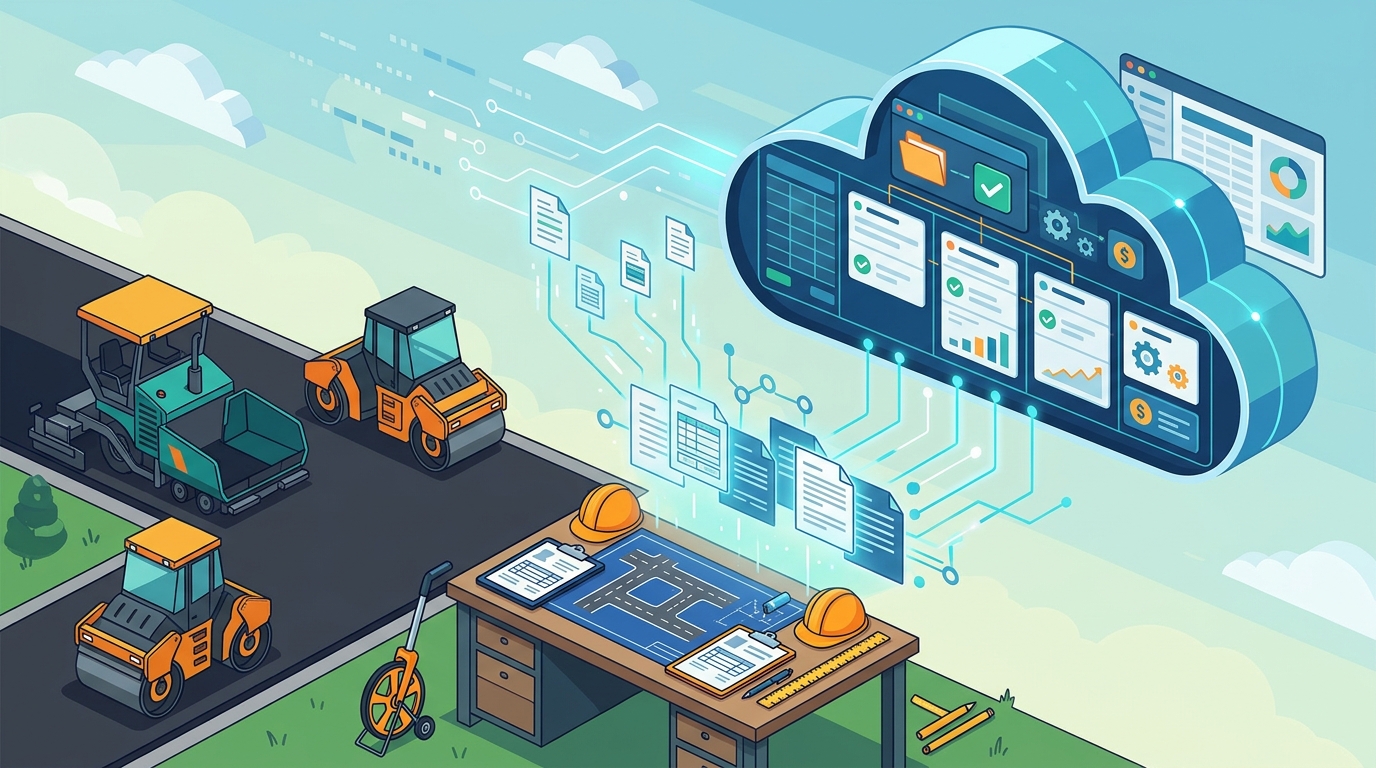
Paving contractors are moving estimates to the cloud to eliminate version control errors, enable real-time team collaboration, and secure critical business data. Cloud-based pavement software replaces fragile local spreadsheets with a centralized platform that tracks every project stage. This shift allows firms to create professional proposals faster while maintaining a single source of truth for their entire sales pipeline.
The Fragility of Local Spreadsheet Management
Traditional spreadsheet management is a localized data storage method that relies on individual computer files to track business operations. This approach creates significant operational risks for pavement companies. When estimates live on a single desktop or a shared local drive, the data is vulnerable to hardware failure, accidental deletion, or version conflicts. If a salesperson updates a bid on their laptop while the office manager works on a different copy, the company loses track of the current pricing. This fragmentation leads to miscommunication and lost revenue opportunities.
Cloud-based pavement software is a web-hosted application that stores all project data on secure remote servers. This architecture ensures that every team member accesses the same information simultaneously. For a paving firm, this means the estimator, the project manager, and the owner all see the same live data. The risk of working from an outdated file is eliminated entirely. This structural change provides a foundation for reliable business operations.
Real-Time Collaboration Across the Field and Office
Field-to-office communication is a data synchronization process that connects on-site measurements with back-office administrative tasks. In the past, this required phone calls, emails, or physical paperwork. A crew chief might measure a driveway on-site, then spend hours later entering that data into a spreadsheet at the office. This delay creates a gap in the sales cycle. Customers expect fast responses, and manual data entry slows down the proposal process significantly.
Modern cloud platforms allow for instant data updates from any device. A field team can capture measurements and images directly from a tablet or smartphone. This data syncs immediately to the central system. The office team can then build the proposal while the crew is still on-site. This speed is a critical competitive advantage. It demonstrates professionalism to the customer and allows the company to respond to bids before competitors do.
Standardizing the Sales Process for Consistency
A standardized sales process is a defined sequence of steps that guides a company from initial contact to final contract. Without a defined process, every employee may handle a lead differently. One estimator might include a detailed scope of work, while another might send a simple price list. This inconsistency confuses customers and makes it difficult to track performance. It also makes it hard to train new staff effectively.
Enhancing Proposal Quality and Customer Experience
Proposal quality is a measure of the clarity, professionalism, and persuasiveness of a business bid. A well-crafted proposal is more likely to win a contract than a simple price quote. Spreadsheets often produce plain, text-heavy documents that are difficult for customers to read. They lack visual context and fail to explain the value of the work being performed. This can lead to customers choosing a lower bid simply because it looks easier to understand.
Cloud-based tools allow for the creation of rich, visual proposals. These documents can include images of the site, marked-up plans, and clear scope descriptions. This visual approach helps customers understand exactly what they are buying. It builds trust and positions the company as a professional partner rather than just a vendor. A high-quality proposal justifies premium pricing and reduces the likelihood of scope disputes later in the project.
Scalability and Long-Term Business Growth
Business scalability is the ability of a company to grow its operations without a proportional increase in complexity or cost. As a pavement company grows, the number of projects and users increases. Local software often struggles with this growth. It may require expensive hardware upgrades or complex network configurations. It also becomes harder to manage user permissions and data access as the team expands.
Cloud solutions are designed to scale seamlessly. Adding a new user or a new project type is a simple administrative task. The infrastructure is managed by the provider, so the company does not need to worry about server maintenance. This allows the business to focus on growth rather than IT management. It also provides a secure environment for sensitive financial data. As the company expands, the software grows with it, ensuring that the sales process remains efficient and secure.
Key Takeaways
- Cloud-based pavement software is a centralized platform that eliminates the risks of local file management.
- Real-time data synchronization allows field teams and office staff to collaborate instantly.
- Standardized workflows ensure that every proposal follows a consistent, professional format.
- Visual proposals improve customer understanding and increase the likelihood of winning bids.
- Cloud infrastructure supports business growth by scaling easily with the number of users and projects.
- Centralized data provides a single source of truth for tracking the entire sales pipeline.
Frequently Asked Questions
What is the main advantage of cloud software over spreadsheets?
The main advantage is real-time collaboration and data security. Cloud software ensures that all team members work from the same up-to-date information, eliminating version control errors and data loss risks associated with local files.
How does cloud software improve the speed of proposal creation?
Cloud software allows field teams to input data directly from mobile devices. This data syncs instantly to the office, where proposals can be generated and sent while the crew is still on-site, significantly reducing response times.
Is cloud-based pavement software difficult to learn?
Most modern cloud platforms are designed with user-friendly interfaces. They often include guided workflows and tutorials that help new users become proficient quickly, reducing the training burden on the company.
Can cloud software integrate with other business tools?
Yes, many cloud-based pavement solutions offer integration capabilities with accounting software and other business tools. This allows for a seamless flow of data from the sales process to financial reporting.
How does a standardized process help with training new employees?
A standardized process provides a clear framework for new employees to follow. They can learn the exact steps required to create a proposal, ensuring consistency and reducing the time needed to become productive.
What happens to data if a local computer fails?
If data is stored locally, it may be lost if the computer fails. Cloud software stores data on secure remote servers, ensuring that the information is backed up and accessible from any device, even if a local machine is damaged.
Conclusion
The shift from spreadsheets to cloud-based software is a necessary evolution for pavement companies seeking to grow and compete effectively. By adopting a centralized platform, firms can eliminate data risks, improve collaboration, and standardize their sales process. This transition leads to faster response times, higher quality proposals, and better visibility into business performance. For pavement professionals, the cloud is not just a technology upgrade; it is a strategic tool for building a more efficient and profitable business. To see how this transition works in practice, you can explore the PavementLayers platform and start your 14-day trial today.